
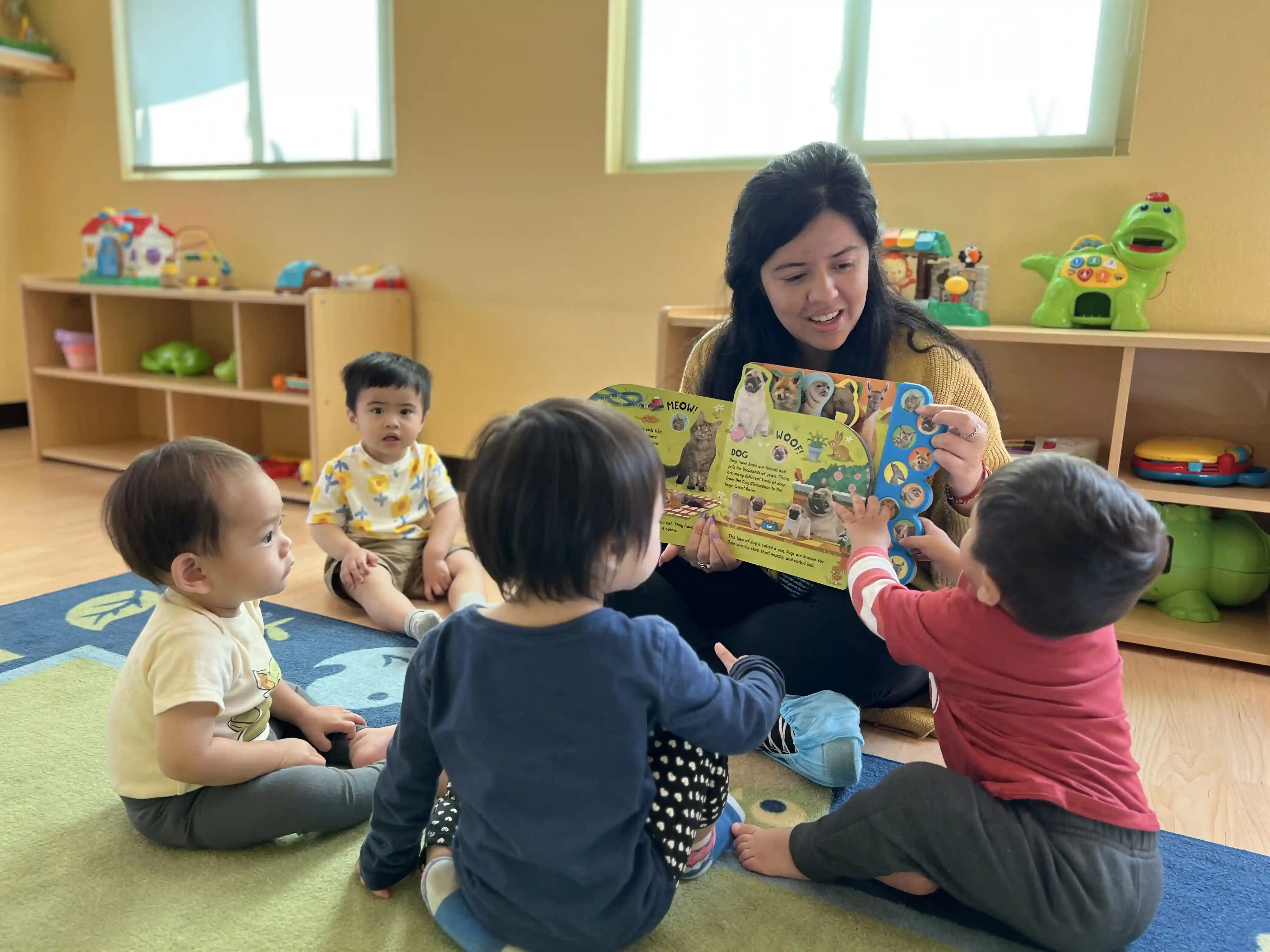
“He can’t focus for two minutes” and “she’ll do puzzles for an hour” are frequently reports about the same child, because preschool attention isn’t one number, it’s a set of gears: self-chosen play runs long, adult-chosen tasks run short, and the difference is development, not defiance. Attention span is also buildable, one of the most buildable capacities in early childhood, and the methods look nothing like demanding stillness. Here’s the working guide from the classrooms at O.C. Kids Preschool in Garden Grove.
Key takeaways
- The working rule for adult-directed attention is a few minutes per year of age, a four-year-old managing 8–12 minutes of someone else’s agenda is on target.
- Self-directed attention runs far longer and is the training ground: the hour-long puzzle session IS focus practice.
- Attention builds through play that carries its own demands, pretend roles, games with rules, building projects, not sitting drills.
- The great eroders: interruption-rich environments, background TV, and fast-cut media that trains the reflex to expect novelty every few seconds.
- Movement feeds focus, the wiggly child usually needs more big play before the sit, not more correction during it.
What’s a normal attention span at this age?
Two different numbers, and the distinction rescues most parental worry. Adult-directed attention: focusing on something someone else chose, at their pace: the working classroom rule is a handful of minutes per year of age, meaning a three-year-old holds six-to-nine minutes of circle time and a four-year-old eight-to-twelve, with fatigue, hunger, and interest moving the number daily. This is the gear kindergarten will lease, and it matures slowly because it runs on the brain’s latest-building systems. Self-directed attention: focus on something the child chose: dramatically longer, sometimes startlingly so, the forty-five-minute block city, the hour of theme-bin sorting, because motivation does the heavy lifting and the child controls the pace. The parental error the two-gear model corrects: reading the gap as character (“he CAN focus, he just won’t for me”), when the gap IS the developmental profile. Every preschooler runs long on their gear and short on yours, the ratio improves on a schedule, and the long self-chosen sessions aren’t the enemy of classroom focus, they’re its gym.
What actually builds attention span?
Activities that smuggle focus-demands inside motivation, the classroom’s whole method. Pretend play with roles: the classic finding, a child asked to stand still lasts moments; the same child playing castle guard stands remarkably longer, because a role is a self-imposed rule, and holding it exercises exactly the inhibition muscle adult-directed attention needs. Games with rules: freeze dance, Simon Says, red-light-green-light, and simple board games all require attending, waiting, and inhibiting on cue, focus drills wearing party clothes. Project play with natural arcs: puzzles, construction, cooking projects, and the theme-based investigations that stretch across a month carry built-in completion pressure, the tower wants finishing, the seed chart wants updating, which extends persistence gently, one increment at a time. Read-alouds with engagement: the listening span grows book by book, especially with prediction and discussion woven in. And movement, counterintuitively: vestibular and heavy-work input is attention’s fuel, the outdoor blocks exist partly so the rug times can work, and the wiggly child’s prescription is nearly always more big play before the sit. What every method shares: the child is pulled through the focus demand by wanting, not pushed by compliance, the only engine strong enough at four, and the one that builds the machinery duty will drive later.
What erodes attention, and what does the screen research say?
Interruption is the main enemy, in three costumes. The interruption-rich environment: attention grows in stretches and dies in fragments, and well-meaning adults are chronic fragmenters: the check-in questions mid-play, the schedule chopped into ten-minute pieces, the toy rotation that resets engagement before depth arrives. The fix is architectural: protected play blocks (classrooms defend long center times for exactly this reason), and the adult discipline of joining play without hijacking it. Background TV: the quiet eroder, a television running unwatched measurably shortens toddler play episodes and reduces their complexity, while also cutting parent-child talk; “nobody’s watching it” is precisely the problem, and off is the easy win. Fast-cut media: the evidence on pacing suggests what parents intuit, rapid-fire editing trains an expectation of external novelty every few seconds, the exact opposite of internally-sustained attention; slower, story-shaped programs are gentler on this axis. What doesn’t erode attention: high energy, physicality, or the two-gear gap itself, the child who wiggles through circle and then sorts dinosaurs for an hour has a normal profile. The genuine flags, a child who can’t sustain even chosen play, flitting constantly across settings at ages where peers have settled, belong in the teacher-and-pediatrician conversation, assessed against development rather than against a worksheet’s demands.
How do we build focus at home without becoming drill sergeants?
Protect, stretch, and model, three habits, no worksheets. Protect the deep-play block: engineer one daily stretch, even twenty minutes, where absorbed play runs uninterrupted, no questions, no transitions, no helpful suggestions; when you must end it, end with warning and honor (“five more minutes, want a photo of the tower first?”), because how play ends teaches whether depth is safe. Run the interruption audit on yourself too: the parental phone-check that pulls you out of a shared game pulls the child out with you. Stretch the arcs gently: one puzzle piece past the frustration point, one more page of the longer book, the two-day project that waits overnight on the counter, increments praised as persistence (“you stuck with it”), never framed as endurance tests; and play the rule-games as family sport, freeze dance in the kitchen is focus training the child will request. Model single-tasking out loud: children calibrate attention norms off the household, a family where adults finish things, read visibly, and announce their own focus is running the ambient curriculum. And keep the target honest: the goal is not a preschooler who sits still on command, it’s a child whose focus grows a minute at a time inside things worth focusing on, until the school years arrive to find the machinery built.
Frequently asked questions
My four-year-old can’t sit through dinner. Normal?
Family dinner is adult-directed attention at the end of a spent day, the hardest gear at the worst hour. Keep dinners short-ish, include them in the talk, and let the standard grow with the child.
Is my child’s hour of puzzle focus “hyperfocus” I should worry about?
Long absorbed play in a child who also transitions, engages people, and plays flexibly is the healthy version, the gym session. It’s a flag only alongside rigidity, distress at any interruption, and narrow-interest patterns across settings.
Does circle time train attention or just test it?
Both, when sized right, short circles at a minute-per-year-of-age build the group-attention gear without overdrawing it.
When would attention concerns warrant evaluation?
When focus fails across BOTH gears and settings, can’t sustain even chosen play, at home and school, unlike age-mates, or when impulsivity puts safety and friendships at risk. That pattern earns the conversation; a wiggly circle performance alone doesn’t.
Come watch a protected center-time hour, deep focus, aged four, in its natural habitat. Call (714) 530-7263, O.C. Kids Preschool in Garden Grove.