
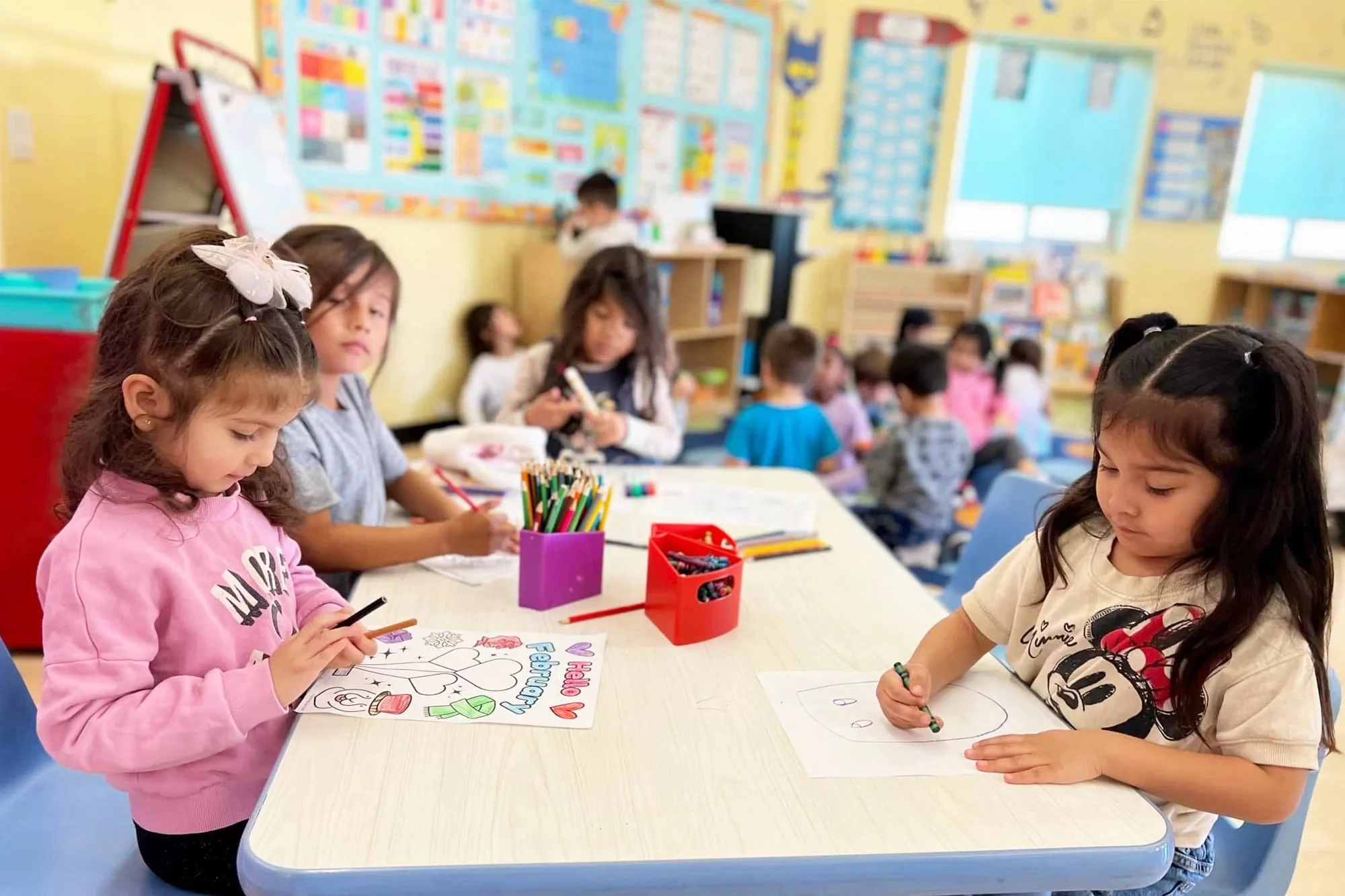
Ask what role tablets play in the classroom and you learn a lot about a preschool. Our answer at O.C. Kids Preschool in Garden Grove is simple: children spend their day with hands in play-dough, not on glass. Pediatric guidance for this age recommends very limited, high-quality screen use, and since most children already meet or exceed that at home, a preschool's job is to supply what screens can't: three-dimensional play, face-to-face conversation, and boredom that turns into ideas. Screen use at OC Kids is limited to using our big screen TV for virtual tours or education videos when concepts make sense to do so, or in our TK class children have our computer lab and tablet for coding as a part of our STEAM program all built around hands on learning not diluted non education screen time.
Key takeaways
- Pediatric guidance for ages 2–5 caps recreational screen time around an hour a day of quality content, co-viewed. That's a budget most family life already spends without school adding to it.
- Young brains learn best from 3D interaction: a virtual shape-sorter and a real one are not the same lesson to a developing hand and eye.
- Screens in classrooms displace exactly what preschool exists for: conversation, conflict practice, and pretend play.
- A screen-free policy is sequencing, not technophobia: keyboards can wait; scissors can't.
- Ask any program precisely how screens are used. “Educational tablet time” deserves follow-up questions.
What does the research actually say about screens at this age?
The consistent picture across pediatric guidance: under 18–24 months, avoid screens outside video chat; from two to five, keep it to roughly an hour of quality programming, ideally watched with an adult who talks about it. Two findings matter most for preschool decisions. First, the transfer deficit: toddlers demonstrably learn less from a screen demonstration than from the same demonstration by a live person. Young brains discount the glass, and the discount is steep exactly when language and concepts are being built fastest. Second, displacement: the documented costs of heavy screen time come less from content than from what it replaces, namely conversational turns, physical play, and sleep. A preschool that adds screen hours to a child's day is spending a budget the family already spent, and spending it on the lowest-yield input available to a developing brain. The room full of blocks, paint, and arguing four-year-olds isn't the nostalgic option; by the evidence, it's the high-performance one.
our Garden Grove programs preschool in Garden Grove
What fills the day instead?
The irreplaceable stuff. Blocks and puzzles build the spatial reasoning people hope apps teach, but with weight, balance, and consequence a simulation can't supply. The dramatic play corner runs the social curriculum: negotiating who's the doctor builds more executive function than any matching game. The sensory bins and easels build the actual hand that will someday type. Outside, twice daily, children bank the full-body vestibular input that regulates attention, the thing a wiggly kindergartner at a desk is missing. The monthly themes thread it together: theme-based learning delivers the vocabulary and concepts screen media promises, through five senses instead of one pane of glass. And woven through all of it, thousands of live conversational turns with teachers and peers, the strongest language-growth engine known, and the input a screen structurally cannot provide, because screens don't respond to your child; people do. None of this is a throwback. It's what the developmental evidence says this age needs most and screens deliver least.
How should families handle screens at home without a fight?
Structure beats willpower. Anchor screens to a predictable slot (after dinner, before bath) so “is it show time?” has a factual answer instead of a negotiation. Keep them out of the two places research flags hardest: mealtimes, where conversational turns live, and the hour before bed, where light and stimulation tax sleep. Prefer slower, story-shaped programs over fast-cut content, and watch together when you can; a show you talk about becomes language practice. Expect protest when routines change, and let it be boring protest; it starves in days. Background TV deserves its own line: a television running unwatched measurably shortens children's play episodes and cuts parent-child talk even when nobody's watching it. Off is the easy win that requires changing nothing else. And be gentle with yourselves: the guidance is a target, not a tribunal. A family that keeps meals and bedtime screen-free and talks a lot is doing the heavy lifting, whatever the weekly tally says, and their child spends the school day in a room where the question never comes up at all.
Frequently asked questions
Do you ever use screens at all?
Purposefully, yes: the big-screen TV for a virtual tour or an educational video when the concept calls for it, and in our TK class a computer lab and tablet for coding as part of the STEAM program. What we don't run is tablet time as a default activity or a way to fill the day; ask on your tour and we'll walk you through exactly what a day contains.
Is video-chatting grandparents bad for a toddler?
No. Live video chat is the standing exception in pediatric guidance, because it's a real conversation with a real person who responds. Wave at ông bà freely.
My child already watches more than an hour a day. Is the damage done?
There's no damage ledger. Displacement works both ways, and every screen-free mealtime and bedtime story starts paying back immediately. Adjust the routine, skip the guilt.
What about the rainy days? Movies then?
Not as the plan. Rainy days run the indoor movement playbook: obstacle courses, dance blocks, balloon games. Ask us what last rainy Tuesday actually looked like; there's a specific answer.
Come watch what a screen-free morning sounds like at full volume. Call (714) 530-7263 to tour O.C. Kids Preschool in Garden Grove.