
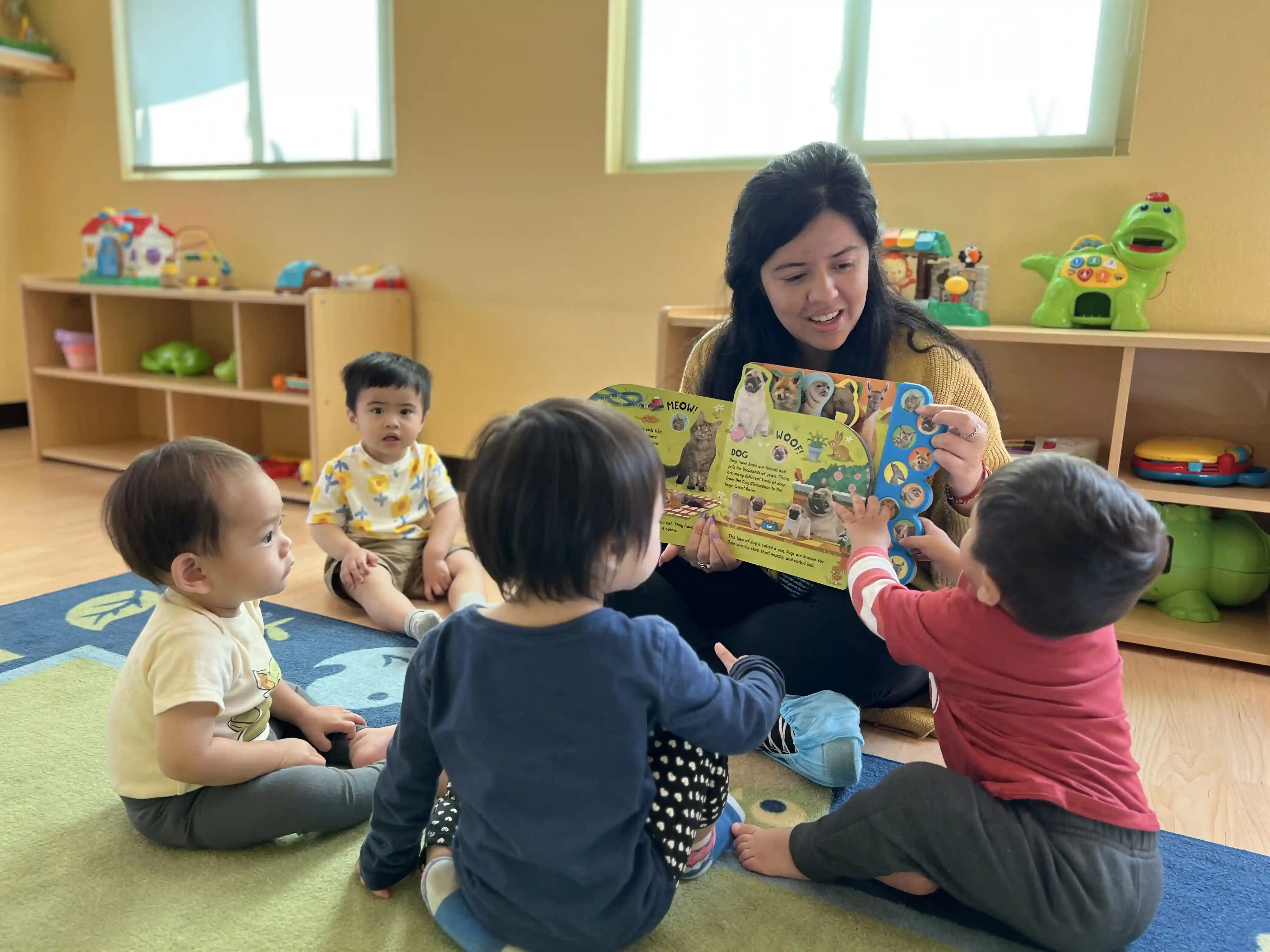
Preschool teachers run the most rigorous book-testing laboratory in existence: a story that can hold a rug full of four-year-olds at 11 AM has passed a trial no bestseller list can simulate. Ask the teachers at O.C. Kids Preschool in Garden Grove what actually works, and patterns emerge fast: by age, by feature, and by the mysterious quality that makes a child demand the same book forty times. Here’s the field guide: what makes a great read-aloud at each age, and how to run story time at home like someone who does it for a living.
Key takeaways
- Great read-alouds are age-engineered: toddlers need rhythm and repetition; threes need patterns with surprises; pre-K can handle real plots.
- The features that survive the rug: refrains children can join, questions to shout answers at, and language written for the ear.
- The fortieth reread is the curriculum, not a rut: repetition is how vocabulary, structure, and prediction consolidate.
- Interactive reading (pausing, wondering, letting them finish lines) roughly doubles a book’s language value.
- The best home library is a rotating dozen from the library, not a hundred owned spines, and books in every home language count double.
What makes a book work for each age?
The spec changes fast, and matching it is most of the magic. Ones and young twos want sound over story: strong rhythm and rhyme (the text as music), one idea per page, things to point at and name, and physical participation (flaps, touches, animal noises); narrative is optional because narrative isn’t installed yet. Older twos and threes want pattern-plus-payoff: cumulative and repeating structures they can predict, refrains to chant along, gentle surprises inside the sameness, and the first real story arcs (problem, attempts, resolution) kept short. This is the golden age of the book where the class shouts NO at a misbehaving pigeon, which is oral language practice disguised as anarchy. Fours and fives graduate to real plot: characters with feelings and motives (the theory-of-mind years want minds to read), humor with mild sophistication (the narrator who’s wrong, the character who doesn’t know what the reader knows: irony’s training wheels), richer vocabulary worth stopping for, and lengths that build listening stamina toward the chapter-book frontier. The cross-age constant: language written for the ear. Read a candidate aloud in the store; if your mouth enjoys it, the rug will.
Why does my child want the same book every night for a month?
Because repetition is how this age converts a story into equipment: the fortieth read is doing different work than the first. The research on repeated reading is satisfying: children learn new vocabulary better from the same book reread than from the same words spread across new books, because each pass frees attention: the plot known, the mind can afford the words; the words known, it can afford the structure; the structure known, it starts predicting, and prediction is comprehension’s engine warming up. Watch the arc across a book-obsession month: first reads are pure reception; middle reads sprout participation (finishing lines, correcting your errors, and they will audit you word-perfectly, because their version is now canonical); late reads flip the roles, with the child “reading” the memorized text to you, page-turns cued by pictures, which is pretend-reading: a genuine pre-literacy milestone wearing the costume of a party trick. The obsession also serves emotional work: children fixate on books processing their current frontier, running the scenario safely on repeat until it’s metabolized. So, surrender to the run, keep your delivery honest on read thirty-one, and know the run ends on its own, usually the week you finally memorized it too.
How do teachers actually read aloud, and what’s stealable?
Interactively: the technique with the strongest evidence in early literacy, and every part of it travels home. The formal name is dialogic reading: instead of performing the text at a silent audience, the reader makes the child a co-teller, and studies show meaningful language gains from exactly this shift. The stealable moves: pause at the predictable (stop before the refrain’s last word and let them land it); the completed line is retrieval practice with applause built in. Ask real wonderings, sparingly (“what do you think happens next?” at the page-turn, “why is he sad?” at the face), one or two per book, not a quiz per page; over-questioning converts story time into assessment, and children file assessments under avoid. Feed the vocabulary in passing: hit the good word with relish, gloss it in four words (“enormous: that means SO big”), and move on. Point at print occasionally: run a finger under the refrain; light print-referencing measurably builds print concepts. Do the voices badly and commit: performance quality is irrelevant; performance willingness is everything. And the master move, stolen from every great rug teacher: let the book end. No moral appended, no comprehension debrief: the silence after the last page, with the child staring at the cover, is the sound of it landing.
How do we build the home library without buying a bookstore?
Rotate small, own the sacred few, and use the library like the municipal treasure it is. The working system: a display of roughly a dozen books at child height, rotated every few weeks. A small fresh shelf gets read; a hundred-spine wall gets ignored. The Garden Grove library branches are the rotation’s engine: armloads of books for free, children’s librarians who are professional matchmakers (tell them your child’s current obsession and watch them work), and story times that add group-listening practice. Own permanently only the sacred tier: the current obsession (library copies of a forty-read book create due-date tragedies), the bedtime canon, and the family-specific books, including books in your home language, which count double: for Garden Grove’s many bilingual households, the read-aloud in Vietnamese or Spanish or Korean builds the same literacy foundation as the English one, and the research is emphatic that a warm read-aloud in your strongest language beats a stilted one in English every time. Bonus infrastructure: a book basket in the car, books in the lowest kitchen drawer, and the used-book-sale habit for guilt-free volume. Twenty minutes, one lap, one book chosen by a small dictator: the entire program, and it outperforms everything sold to replace it.
Frequently asked questions
My child won’t sit for books. He wanders off mid-page. Broken?
Normal, especially for the kinetic ones: keep reading while he orbits (the ear stays enrolled after the body leaves), pick shorter and more participatory books, and try captive venues: bath, meals, bed.
Are nonfiction books good read-alouds at this age?
Excellent ones: preschoolers are information omnivores, and the truck and shark books drive vocabulary conversation even harder than stories. Follow the obsession.
Should I correct her when she “reads” the memorized book wrong?
Never: pretend-reading is rehearsal, and correction converts it to performance review. Enjoy the show; the accurate version arrives with actual reading, on schedule.
What does the classroom read, and can we sync at home?
Ask anytime: the current rug favorites and theme books are posted in the room, and home copies of school hits are the easiest reading wins available: pre-sold, pre-loved, arriving with inside jokes attached.
Ask the teachers what’s surviving the rug this month: it’s the best book list in town. Call (714) 530-7263, O.C. Kids Preschool in Garden Grove.