
- The American Academy of Pediatrics recommends zero recreational screen time for children under 18 months and a maximum of 1 hour per day for ages 2 to 5.
- Children under 8 average nearly 2.5 hours of daily screen media, more than double the AAP guideline, per Common Sense Media (2023).
- A landmark Science study found Montessori students outperformed peers on executive function, reading, math, and positive social interactions.
- Background television reduces parent-to-child verbal exchanges by an estimated 770 words per hour, directly slowing language development.
- Not all screen time is equal, video chatting with a caregiver and parent-guided co-viewing are fundamentally different from passive solo viewing.
It happens in almost every household. A toddler reaches for a phone. A parent, exhausted or mid-task, hands it over. Within seconds the child is quiet, absorbed, seemingly content. And the parent wonders: is this okay? Am I hurting them? How does this compare to what they do at preschool?
These are not small questions. The first five years of life represent a period of rapid brain development unlike any other. The experiences children have during this window, including the amount of time they spend in front of screens versus in hands-on, language-rich environments, shape the neural architecture that underlies language, attention, self-regulation, and social connection.
This post cuts through the noise. Here is what the research actually says, what the major health organizations recommend, and how a Montessori approach to early learning is built around the science of how young children's brains develop.
explore our Montessori-informed programsWhat Major Health Organizations Actually Recommend
The guidance from every major pediatric health body is consistent and more conservative than most parents realize. The American Academy of Pediatrics (2023) recommends zero recreational screen time for children under 18 months, with one narrow exception for video chatting with a caregiver. For children ages 2 to 5, the AAP caps quality screen time at one hour per day and specifies that parents should watch alongside their children to provide context.
Citation Capsule: The World Health Organization's 2019 guidelines on physical activity, sedentary behavior, and sleep align closely with the AAP: no sedentary screen time for children under 2, and no more than one hour for children ages 3 to 4, with the explicit note that less is better.
The reality in most households diverges sharply from these guidelines. According to Common Sense Media's 2023 Census, children under 8 average close to two and a half hours of daily screen media, more than double the AAP ceiling for the age group. In the 0-to-2 category, average daily screen exposure already exceeds the recommendations set for children twice their age.
Understanding why these guidelines exist, not just accepting them, is what helps parents make better daily decisions.
Minutes per day | Sources: AAP (2023), Common Sense Media (2023)
How Passive Screen Use Affects the Developing Brain
The infant and toddler brain is not a passive receiver. It is a construction site. From birth through age five, the brain forms more than one million new neural connections every second, according to the Center on the Developing Child at Harvard University. Those connections are built primarily through interaction: a caregiver naming an object, a child reaching and being responded to, a conversation about what just happened at the park.
Passive screen viewing does not provide this. Content may move, light up, and make sounds, but it cannot read a child's facial expression, slow down when the child is confused, or repeat a word in a new context the way a present adult does. The interactive feedback loop that drives early brain development is absent.
Citation Capsule: A landmark study by Christakis and colleagues, published in JAMA Pediatrics, found that for every hour of background television in a household, children heard approximately 770 fewer adult words. Language acquisition in early childhood is built on the quantity and quality of language directed at a child, background TV silently subtracts from that total.
A 2019 study published in JAMA Pediatrics (Madigan et al.) followed children through early childhood and found that higher screen time at ages 24 and 36 months predicted lower scores on developmental screening measures at ages 36 and 60 months. The effect was particularly notable for language and communication domains.
The NIH-funded Adolescent Brain Cognitive Development (ABCD) study, one of the largest long-term brain imaging studies of children in the United States, found that children who spent more than two hours daily on screens consistently scored lower on tests of thinking and language compared to peers with less screen exposure. Children with the highest screen time also showed measurable differences in the structure of the cortex, the brain region governing attention, decision-making, and impulse control.
What Montessori Hands-On Learning Does Differently
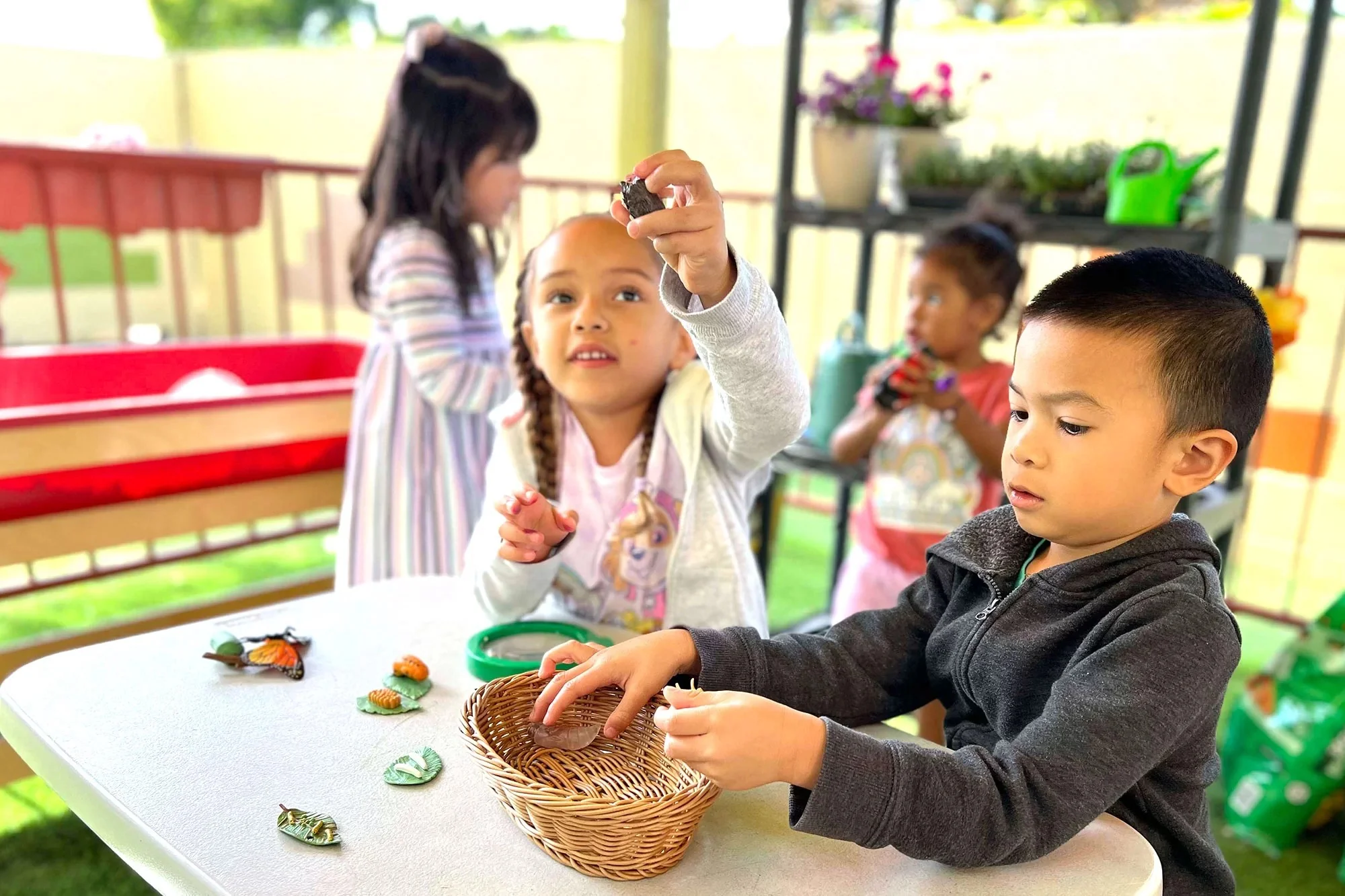
The Montessori method is built around a single insight backed by over a century of observation: children learn through their hands, their senses, and their choices. Every material in a Montessori classroom is designed to isolate a concept and invite physical manipulation. A child counting wooden beads, pouring water between pitchers, or tracing sandpaper letters is not being entertained, they are building understanding through action.
Citation Capsule: A landmark study by Lillard and Else-Quest, published in Science (2006), compared children ages 5 and 12 in Montessori schools to peers in conventional programs. Montessori children outperformed controls on measures of executive function, reading, math, positive social interactions, and sense of community. These gains were most pronounced in younger children, the exact age group where the screen-time question is most urgent.
What makes Montessori particularly relevant to the screen-time conversation is its emphasis on what researchers call "serve and return" interaction, the back-and-forth exchanges between a child and a responsive adult that the Harvard Center on the Developing Child identifies as the primary driver of early brain architecture. Montessori teachers are trained to follow a child's lead, narrate what they observe, and ask questions that invite language rather than delivering information. This is the opposite of a passive screen experience.
Montessori classrooms also deliberately limit passive stimulation. Materials are beautiful but calm. There are no flashing lights, no audio rewards for correct answers, no algorithmic sequences designed to maximize engagement time. Instead, the environment is designed to cultivate intrinsic motivation, a child doing something because it is satisfying, not because the app gives a star.
learn about our Montessori curriculum approachResearch-informed ratings (1–5) | Based on Lillard & Else-Quest (2006), Harvard CDChild, JAMA Pediatrics research
Not All Screen Time Is Equal
The research is clear that passive solo screen viewing poses the greatest risk to early development. But the science also supports a more nuanced view. Not all screen exposure is equivalent, and parents who understand the distinctions can make better decisions without guilt spirals over every moment a device appears in the room.
Video chatting is meaningfully different from passive viewing. A 2016 study found that infants as young as 12 to 15 months could learn new words from a live video interaction with an adult, something they did not demonstrate when the same content was shown as a pre-recorded video. The contingent response of a real person makes the difference. FaceTime with grandparents is not the same as YouTube autoplay.
Co-viewing with active parental narration also shifts the equation. A parent who watches a nature documentary with a 4-year-old and narrates, "Look, that bird is using its beak to dig for food, like how we use a spoon", is doing something fundamentally different from a child watching the same content alone. The parent's language bridges screen content to real-world understanding.
The Language Gap: Why Conversation Beats Content
Vocabulary size at age five is one of the strongest predictors of reading ability in third grade, according to research by the Annie E. Casey Foundation and replicated in multiple longitudinal studies. And vocabulary is built almost exclusively through conversation, not instruction, not apps, not educational videos. Children acquire words by hearing them in context, used by people who respond to them.
This is precisely what a high-quality Montessori classroom provides. Teachers introduce vocabulary through three-part lessons that connect language to physical objects. Children hear precise, rich language from adults and peers across the entire day. Small group discussions, storytelling, and teacher narration during work time all compound into thousands of additional vocabulary exposures that a screen-heavy morning at home does not replicate.
California families face a particular context here. Orange County's diverse language landscape means many OC Kids families are navigating bilingual development alongside standard English acquisition. Screen content, particularly algorithmically curated content, tends to collapse children into a single language register. Classroom environments that include rich conversation in multiple contexts, in English and Spanish at OC Kids, build language breadth that screens simply cannot match.
learn about our dual language enrichment programPractical Screen-Balance Strategies for OC Families
Knowing the research is useful. Having specific strategies is what actually changes behavior. Below are six evidence-informed approaches for families who want to be more intentional without making screens a forbidden object that becomes even more appealing.
- ① Name the purpose before turning on a device. A simple rule: before any screen goes on, one person in the household says why. "We're video calling Grandma." "We're watching one nature episode together." Purposeful use breaks the default-on pattern.
- ② Establish screen-free anchor points in the day. Meals, the hour before bed, and morning routines are high-language, high-bonding windows. Protecting these from devices pays disproportionate dividends in vocabulary and emotional connection.
- ③ Replace passive viewing with something physical before offering a screen. If a child asks for a device, the first response is an alternative: "Let's build something first, then we can watch one episode together." This builds the habit of choosing activity before media, not media as default.
- ④ Narrate co-viewed content in real time. When screen time does happen, sit alongside your child for at least the first few minutes and talk. Connect what you see to something your child knows. This is the single highest-leverage thing a parent can do to convert screen time from passive to educational.
- ⑤ Keep devices out of the bedroom, permanently. Sleep-displaced by screen use compounds the cognitive effects of high screen time. The AAP is unambiguous on this: no devices in children's sleeping spaces, regardless of content type.
- ⑥ Model what you want to see. Children under five do not distinguish between their own screen use and their parents'. Visible phone use by adults during shared time is registered by young children as inattention. Reducing your own visible device use during family time is, according to most child development researchers, more effective than any parental control app.
What a Screen-Intentional Preschool Looks Like
When evaluating a preschool program, asking directly about screen use is a legitimate and important question that most parents do not think to ask. A program that defaults to tablet time for transitions, rainy days, or quiet activities is making a deliberate curricular choice, one that may not align with what the research supports for children under five.
In a Montessori-informed classroom, transitions between activities are handled through physical preparation: putting away materials, moving to a new space, choosing a new work. These transitions themselves build executive function, patience, and self-regulation. They are not inconveniences to be managed with a screen. They are the curriculum.
Look for programs where teachers use language as the primary tool for transitions, conflict resolution, and instruction. Ask what the policy is for media in the classroom. Ask what happens when a child is dysregulated, is the first response a calming device or a responsive adult? The answers tell you whether the program's daily practice matches its philosophy.
Frequently Asked Questions
How much screen time is safe for a 2-year-old?
The American Academy of Pediatrics recommends no more than one hour per day of high-quality programming for children ages 2 to 5, and that a parent or caregiver co-view and provide context. Children under 18 months should have no recreational screen time at all, with the sole exception of video chatting with family members. The WHO guidelines (2019) align closely: no screen time under age 2, and no more than one hour for ages 3 to 4.
Can educational apps actually teach toddlers?
Research on educational apps for children under 3 is mixed, and the evidence of meaningful transfer to real-world skills is thin. Young children struggle with what researchers call the "video deficit", the difficulty of applying learning from a screen to a physical context. Learning that happens in conversation with a responsive adult, or through hands-on manipulation of real objects, consistently outperforms screen-based instruction for children in this age group.
Is Montessori anti-technology?
No. Montessori philosophy is not anti-technology, it is pro-appropriateness. Technology tools become part of the Montessori curriculum once children have the foundational sensory, motor, and social-emotional development to engage with them purposefully, typically in the elementary years. The approach simply recognizes that a three-year-old benefits more from hands-on, sensory experience than from screen interaction, a view that is now well-supported by developmental research.
What is the Montessori approach to screen time at home?
Montessori practitioners generally recommend that the home environment reflect the same principles as the classroom: a prepared environment that invites movement, creativity, and real-world engagement. Practical life activities, pouring, sweeping, food preparation, are more developmentally appropriate for toddlers and preschoolers than screen time. When screens are used, co-viewing with conversation is far preferable to solo passive viewing.
Does too much screen time affect language development?
Yes, and the evidence is consistent. A 2019 study in JAMA Pediatrics (Madigan et al.) found that higher screen time at ages 24 and 36 months predicted lower performance on developmental language screening at ages 36 and 60 months. Background television also directly reduces the quantity of adult speech directed at young children, by approximately 770 words per hour, according to research by Christakis and colleagues. Language is built through conversation, and screens that displace conversation slow acquisition.
The Bottom Line
The science is clearer than the cultural conversation suggests. Passive screen time for children under five displaces the experiences their brains actually need: responsive conversation, physical exploration, sensory engagement, and the kind of back-and-forth interaction with caring adults that literally builds neural architecture. The major health organizations agree. The developmental research agrees. The longitudinal outcome data agrees.
None of this means parents should feel guilt over every imperfect moment. Life is not a controlled experiment, and occasional screen use in a rich, language-filled household does not determine outcomes. What matters is the dominant pattern: is the bulk of your child's waking time spent in movement, conversation, and exploration, or in passive consumption?
A Montessori preschool environment answers that question definitively and every single day. Every morning, the classroom offers children a prepared world of real materials, real challenges, and real relationships. That is not an ideology. It is what the research says children under five need most.
If you want to see what that looks like in practice, schedule a visit to OC Kids Preschool in Garden Grove or Anaheim. Or explore our programs to find the right fit for your child's age and stage.